
2025-2044 Outlook Explores Pathways to a Reliable, Cleaner Grid
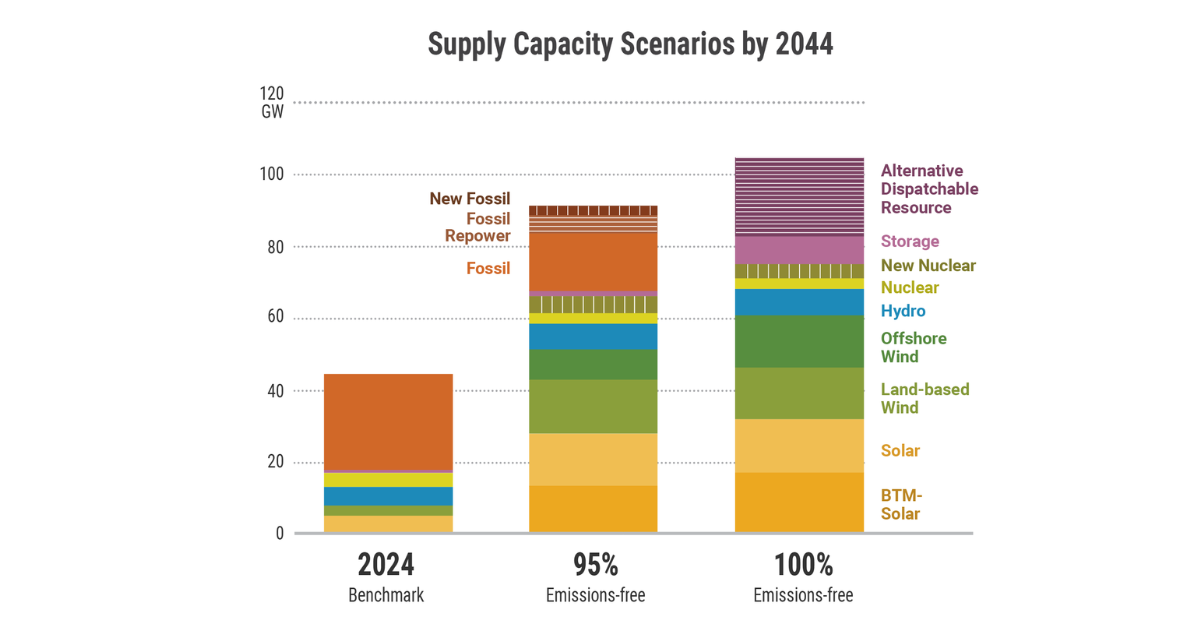
The NYISO's 2025-2044 System & Resource Outlook finds that New York can achieve deep decarbonization through policy pathways that allow for continued, limited operation of fossil fuel, rather than relying exclusively on zero-emissions technologies.
Scenarios with 90 or 95 percent of the state’s electricity generated through zero-emissions technologies can deliver reliability benefits with significantly lower capital investments when compared with policy cases that require a fully zero-emissions grid by the end of the 20-year study period.
The Outlook’s study period overlaps with implementation of the state’s Climate Leadership and Community Protection Act (CLCPA), which calls for a carbon-free grid by 2040.
The biennial report uses a scenario-based approach to evaluate how differences in demand, generation development, and transmission capabilities shape future conditions on the grid.
"The scenario-based approach applied in this edition of the Outlook is becoming increasingly important given the growing uncertainties with demand, resource development, public policy, and other factors impacting the system," said Zach Smith, Senior Vice President of System and Resource Planning for the New York Independent System Operator. "Ultimately, our planning process must provide the clarity necessary to support timely and realistic decisions during this unprecedented transition."
Among the 18 scenarios evaluated, the report highlights two illustrative futures: one aligned with the CLCPA's requirement for a 100% zero-emissions electric system and another that targets 95% zero-emissions electricity. Comparing these scenarios helps illuminate how different policy choices affect future resource needs, infrastructure requirements, and system flexibility.

Key findings
- All policy-driven scenarios examined in the Outlook require two to three times additional generation capacity with a different resource mix than exists today.
- No dispatchable emissions-free technology is available at commercial scale to replace the flexibility that fossil fuel generators provide – making the goal of a zero-emissions grid by 2040 unachievable. The continued, limited operation of fossil fuel resources can provide reliability benefits with lower capital investments.
- Electricity demand is expected to increase over the next two decades, driven by electrification policies and the emergence of new large loads. Together, these trends not only increase total electricity needs but also reshape when and where demand occurs on the system.
- Public policy design directly impacts the scale, timing, and type of future resource development. Futures requiring a zero-emissions grid necessitate higher levels of new generation capacity and a different mix of resources than futures that allow limited emissions from repowered and new dispatchable fossil generation.
- Transmission capability increasingly determines whether new resources can serve load. The location of generation relative to demand makes transmission a critical factor in system performance and public policy achievement.
The latest State Energy Plan echoes the NYISO’s call for modernizing aging fossil fuel generation with newer technologies to reduce carbon emissions and maintain reliability as the grid continues to evolve.

The Outlook advances four principal recommendations to address key system needs:
- A mix of new resources, including more efficient new and repowered fossil generation, is essential. Across all scenarios, the system requires resources that can serve demand during peak conditions and periods of low renewable output. The timely development of these resources depends on public policy, supply chain availability, siting, and permitting.
- Coordinate the timing of resource additions, repowering opportunities, and retirements to reduce transition risk and avoid tightening system conditions. As demand increases and existing generation retires, system conditions become increasingly sensitive to the pace and sequencing of new resource development.
- Increase transfer capability across the Central East transmission interface. Enhancing dynamic voltage support represents an opportunity to reduce congestion, improve energy deliverability, and better utilize existing and future generation as system conditions evolve.
- Support zero-emissions generation development in Northern New York with bulk transmission upgrades to enable energy deliverability from this region.
Together, these recommendations emphasize actions that can minimize risks and support reliable grid operations as demand grows and the resource mix evolves over time.
Learn more
2025-2044 System & Resource Outlook
2025-2044 System & Resource Outlook fact sheet