
Environmental Advisory Council Discusses Scenario-Based Planning, Institutional Decarbonization at May Meeting
The NYISO’s Environmental Advisory Council (EAC) recently met virtually for a discussion on grid reliability, the NYISO’s expansion of scenario-based system planning, and the feasibility of institutional decarbonization and electrification.
The eight-member council — comprised of experts in energy, technology, and environmental policy — examined the complexities of planning for reliability and efficiency in an increasingly uncertain environment.
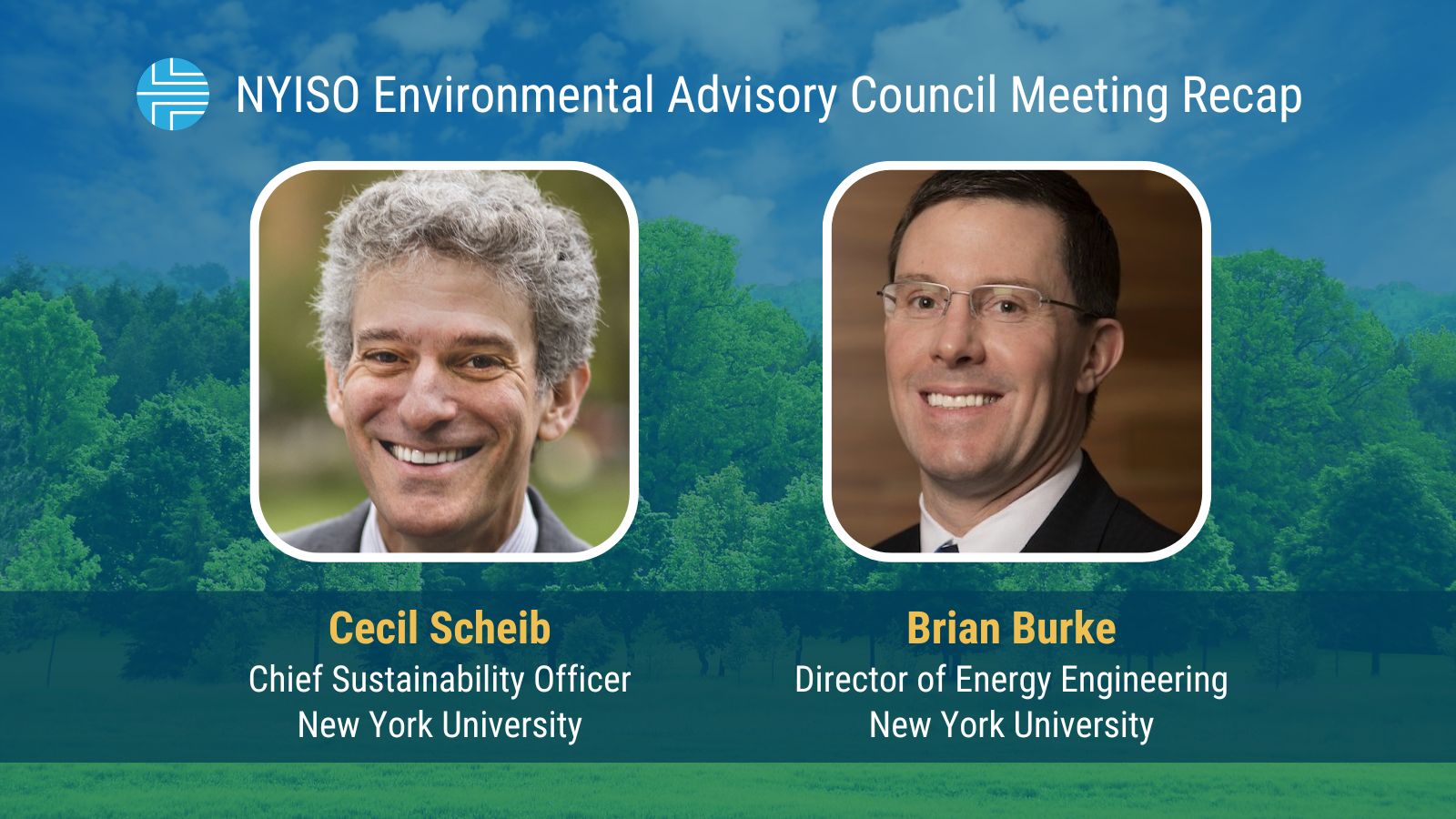
Alongside NYISO executives, the event featured New York University’s Cecil Scheib and Brian Burke, who highlighted lessons from the university’s recent investments in decarbonization and energy efficiency.
The EAC was formed in 2005 to provide the NYISO with information, analysis, and perspectives on the dynamics between evolving state and federal environmental policies and the NYISO’s mission of maintaining reliability of the bulk electric system and administering competitive wholesale electricity markets.
In her opening remarks, NYISO Executive Vice President & COO Emilie Nelson noted that the operating environment has shifted since enactment of the Climate Act in 2019, citing increased uncertainty from federal and state policy changes, supply chain disruptions, geopolitical factors, and emerging load growth.
“While NYISO does not advocate for any particular outcome, we do aim to better understand how these factors intersect with our reliability planning and what that means for the grid over the coming years,” Nelson said. “Your insights as EAC members are an important part of that conversation and we certainly appreciate your engagement.”
NYISO President & CEO Rich Dewey emphasized how the EAC supports the NYISO’s efforts to understand how changing policy, market conditions, technology, and load growth are shaping future reliability and planning needs.
Institutional investment in clean energy
Cecil Scheib, Chief Sustainability Officer for New York University (NYU), led a presentation on the university’s campus-wide decarbonization effort in a densely urban environment, amid challenging policy constraints.
He described how NYU’s strategy has evolved over time toward direct efficiency and electrification investments and away from reliance on offsets.
NYU Director of Energy Engineering Brian Burke described NYU’s tri-generation central plant and thermal network, including the campus distribution of high-temperature hot water and chilled water.
Noting the plant’s layered resiliency approach that helped it withstand Superstorm Sandy, he said university leadership continues to value these resilience benefits when considering electrification options.
Burke also discussed NYU’s operational flexibility (including fuel switching), participation in demand response for certain buildings, and interest in expanding load management strategies. He contrasted NYU’s approximate all-in cost of self-generation with delivered electricity costs for non-cogeneration buildings to illustrate the central plant’s economic role.
Scheib summarized a multi-year study of pathways to decarbonize NYU’s Washington Square thermal loop, which serves 47 buildings. His team evaluated multiple heat supply options (including heat pumps, geothermal, waste heat recovery concepts, and renewable fuels) and emphasized that loop temperature is a key constraint because heat pump solutions perform better with lower temperature distribution.
One finding was that near-complete decarbonization could be achieved while retaining limited natural gas use for a small number of peak heating hours, reducing the scale of needed electrical infrastructure while preserving backup capability.
He also described a geothermal feasibility study that suggested drilling beneath existing parking garages could be technically feasible to generate enough heat, but it would be difficult to execute.
“The fact that it was technically possible, that we could get enough heat just by drilling underneath parking garages, that was a surprising conclusion and one we think other people can learn from,” Scheib said. “Regardless of whether or not it's feasible for us right now, it’s something that people can look at.”
Scheib emphasized that long-term investment decisions in electrification and decarbonization are highly sensitive to uncertain future conditions, creating significant financial and strategic risks for large energy users.
He noted that projects must be evaluated over multi-decade periods, where outcomes depend heavily on variables such as future electricity and natural gas prices, transmission and distribution cost trajectories, and broader policy execution.
His presentation prompted robust discussion with NYISO leaders and EAC members who inquired about financial, logistical, regulatory hurdles around large-scale retrofitting of campus infrastructure.
“Congratulations on the phenomenal work that you've done,” Dewey said. “It's always good to see these success stories and what's achievable.”
Operational reliability
Aaron Markham, NYISO Vice President of Operations, presented on seasonal reliability challenges from the perspective of the control room, with a focus on the June 2025 heatwave and the cold stretch in January 2026.
Despite NYISO’s preparatory actions — such as day-ahead commitments, supplemental commitments, calling external capacity suppliers, and activating demand response — NYISO experienced tight capacity conditions, including reserve shortfalls.
He also spoke about the increasing operational significance of behind-the-meter solar, which is shifting the timing of net peak from roughly 3 p.m. historically to 6 p.m. as solar output declines while temperatures remain high. Using a historical comparison, he described how solar has grown from a small impact to a meaningful part of the system’s daily fuel mix.
Markham described emerging summer natural gas constraints, which reduce operational flexibility. He emphasized that widespread regional heatwaves can constrain the availability of emergency support imports because neighboring systems are also tight.
Markham indicated that projected margins this summer are among the lowest in a decade, with emergency operating procedures expected to be critical in maintaining reliability under stressed conditions.
Scenario planning
Yachi Lin, NYISO Director of System Planning, highlighted the organization’s development of scenario planning to address areas of rising uncertainty and better understand the range of potential outcomes for the grid.
She reviewed how planning processes typically start with a baseline condition and then apply scenarios and sensitivities to test robustness in the near-term and long-term.
“Scenario planning has been deployed widely across the industry for a very long time to acknowledge uncertainties,” Lin said. “We use that to explore multiple possible futures and prepare for both positive and negative possibilities.”
She summarized how scenario planning is applied in demand forecasting, transmission planning compliance studies, the Reliability Needs Assessment (RNA), the Comprehensive Reliability Plan (CRP), probabilistic resource adequacy analysis, and the System & Resource Outlook.
She also discussed the upcoming integration of FERC Order 1920 long-term transmission planning requirements into the NYISO’s planning framework.