
New York’s Future Electricity Needs Require Action Today – The NYISO’s Reliability Needs Assessment Identifies Why
New York needs more dependable electricity supply to meet rising demand and replace resources that are retiring or becoming less reliable. The NYISO’s 2026 Reliability Needs Assessment, or RNA, identifies why and provides advance warning of statewide and local electricity shortfalls. The main takeaway from the RNA is this: resource development must begin now.
The study projects insufficient statewide electricity supply beginning in 2033. Local reliability needs emerge a year earlier, in 2032, in New York City and the Lower Hudson Valley, where local supply and transmission capability may be insufficient to maintain service following unexpected equipment failures.
These are related but distinct challenges: New York needs both enough electricity supply and the ability to deliver it where it is needed. Major electricity projects take years to develop, approve, finance, and build. Therefore, investors, industry leaders, and policymakers must begin to address the projected shortfalls before they put reliable service at risk. That means removing barriers to market-based investment by streamlining permitting and approvals, reducing regulatory uncertainty, and preserving clear market price signals that support financing and timely development of dependable electricity resources.
“Treating these future needs as a present-day priority is necessary given the long lead times and regulatory requirements associated with major infrastructure development,” Senior Vice President of System & Resource Planning Zach Smith said.
Shortfalls remain even with projected new resources
The RNA examines the next decade, bringing together expected electricity demand, new energy projects, planned retirements, transmission capabilities, and assistance from neighboring regions. It tests both whether enough supply will be available and whether the system can continue serving customers following unexpected equipment failures.
The study’s principal forecast includes approximately 6,200 megawatts (MW) of proposed solar, wind, and energy storage projects. Even with those additions, the analysis identifies reliability needs.
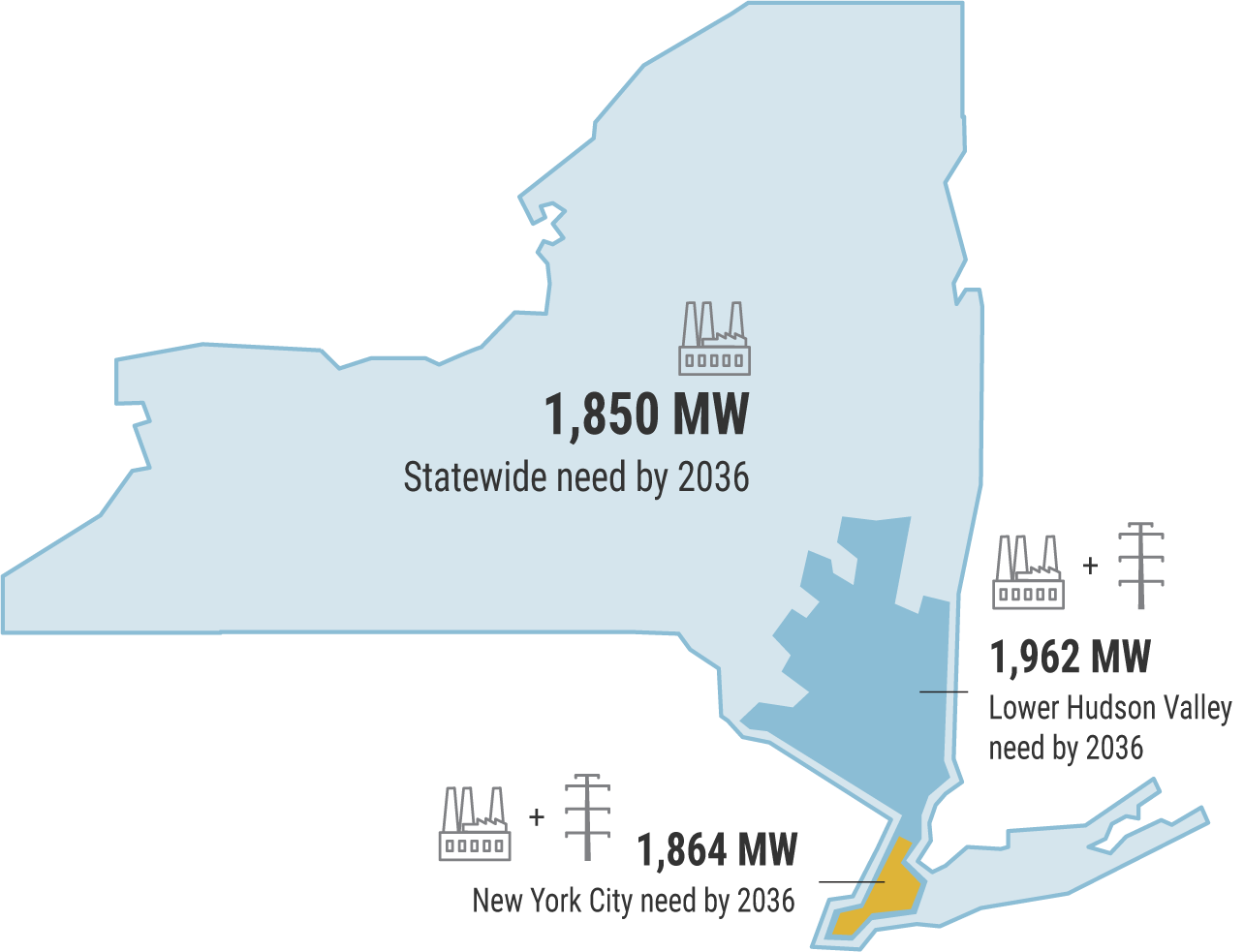
Under the principal forecast, the statewide supply shortfall begins at approximately 225 megawatts in 2033 and grows to approximately 1,850 MW by 2036. Local shortfalls begin in 2032 and grow to approximately 1,950 MW in the Lower Hudson Valley and 1,850 MW in New York City by 2036. The statewide and local figures describe different reliability needs and should not be added together.

Proposed resources must arrive on time and provide dependable electricity when and where the system needs it. Where those resources connect to the grid matters: limited transmission capacity can prevent electricity produced in one region from reaching customers in another. Resource development must therefore consider both local supply needs and the transmission capacity required to deliver electricity, ensuring that new projects help address reliability needs without creating or worsening future delivery constraints.
What’s driving the shortfalls?
The shortfalls are driven by rising demand from new industrial facilities and data centers as well as planned power plant retirements, aging equipment, winter fuel constraints, and reduced assistance from neighboring systems.
The study factors in more than 1,400 MW of planned retirements. In addition, by 2036, a significant portion of New York’s remaining power plant fleet will be more than 70 years old. The RNA accounts for the risk that some older plants will be unavailable when needed. Rising demand in neighboring regions may also reduce their ability to assist New York when systems are under stress at the same time.
On the demand side, the forecast also distinguishes sufficiently advanced development from less certain proposals. The forecast includes approximately 2,700 MW of planned demand from large industrial facilities and data centers, which is far less than the 15,000 MW of proposed large-load demand currently in the NYISO’s interconnection queue.
Continued electrification of the building and transportation sectors is also increasing electricity demand.
Reliability depends on duration as well as supply
Solutions must provide dependable electricity for sustained periods, not just cover a brief spike in demand.
In New York City, for example, modeled shortfalls extend across 16 hours in winter and 15 hours in summer on the high-demand planning day and could recur during peak-demand hours over an extended, multi-day event.
Meanwhile, the Lower Hudson Valley will be deficient by 130 MW for 2 hours in summer 2032, worsening to 1,950 MW for 7 hours in summer 2036.
These modeled shortfall hours are not a prediction that individual customers would lose power for that length of time. Actual interruptions would depend on system conditions and the measures available to manage the shortfall.
What needs to happen next?
New York needs an all-of-the-above approach to resource development, including more dispatchable supply resources that can provide electricity when needed, alongside additional transmission and energy storage. The combination must meet the system’s needs for dependable output, location, and duration. Transmission can help deliver electricity to areas that need it, but transmission improvements alone cannot resolve a statewide supply shortage.
If the identified needs remain, the NYISO will request and evaluate solutions through its 2027–2036 Comprehensive Reliability Plan. That process considers market-based proposals, regulated alternatives, and required regulated backstop proposals. Identifying a need is the first step; proposed solutions must then be evaluated.
The bottom line is New York must begin developing dependable electricity resources now, before the projected shortfalls arrive. The RNA provides advance warning and a foundation for evaluating solutions. Timely development is essential to meeting rising demand and protecting reliable service.