
Winter Weather Strain Highlights Importance of Propel NY Project
Extreme weather is proving to be a persistent challenge for grid operators, highlighting the importance of having sufficient generation to meet spiking demand. But it’s not only generation that matters in these events – transmission plays a critical role too.
Both hot and cold weather events can create a significant increase in demand for electricity as well as reliability challenges due to system constraints or stressed equipment that is operating at its limits. During periods of peak demand, such as the three-day heatwave in June 2025 or the most recent cold snap in January 2026, generating equipment can fail and leave grid operators more reliant on transmission capabilities to move power to where it’s needed. When those transmission lines are at capacity, operators have fewer tools at their disposal to navigate through challenging conditions.
Winter Storm Fern, in late January, highlighted this issue. Although overall demand was substantially lower than in June 2025, constraints on the transmission system meant available generating capacity on Long Island could not be delivered to where it was needed.
The capacity was effectively “bottled” on Long Island and undeliverable to customers elsewhere in the state. As a result, more costly resources had to be called on to supply downstate customers. Bottled capacity underscores the importance of continued transmission investment to support an efficient, reliable, and resilient grid that can withstand extreme weather conditions.
One of the most significant transmission investments underway to address this issue is the Propel NY transmission project, which will expand transmission capabilities between Long Island and the rest of New York. The project is currently scheduled to be in service by May 2030.
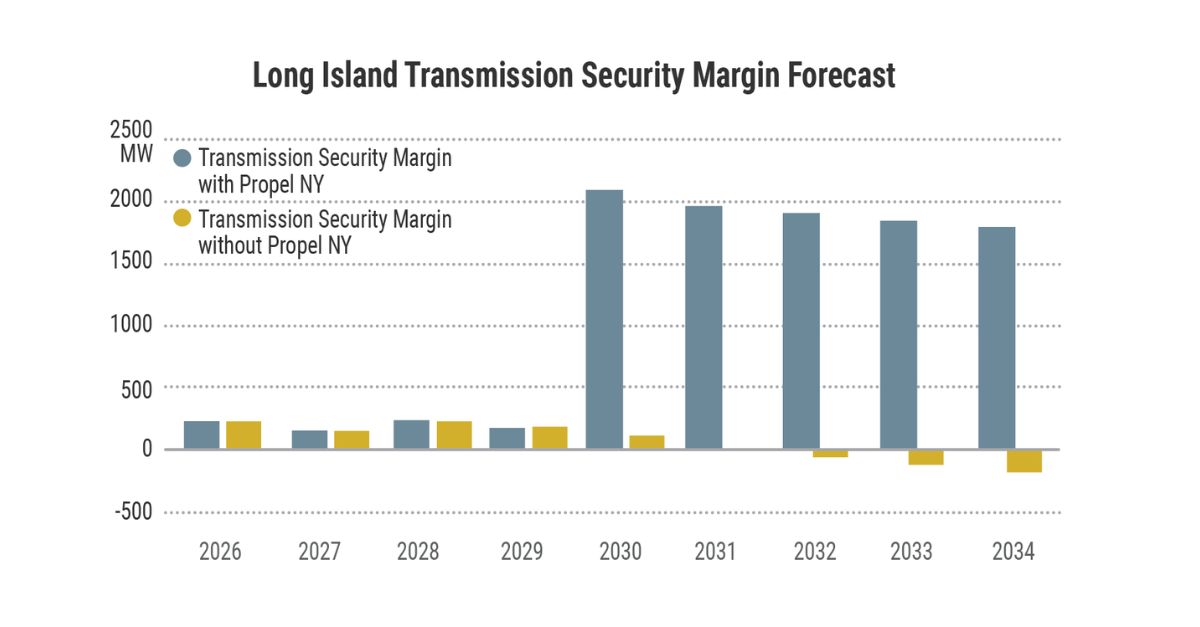
The NYISO’s 2025-2034 Comprehensive Reliability Plan (CRP) identifies Propel NY as a key planned enhancement to the state’s transmission network. While primarily planned to deliver electricity from future offshore wind generation connecting to Long Island to other regions of the state, the CRP emphasizes that future reliability will depend on the system’s ability to manage a wider range of weather variability, evolving resource mix, and fuel supply conditions. Without investment in the Propel NY project, Long Island transmission security margins (a measure of how much stress the system can absorb before it can no longer reliably serve load) are expected to erode completely by 2031.
In this context, expanding the transfer capability between Long Island and the rest of the state can improve the flow of power during stressful conditions, whether driven by extreme cold, unexpected generator outages, or fuel constraints. Had the Propel NY project been in service during Winter Storm Fern, operators would have had additional flexibility to access available generation resources across Long Island, reduce reliance on emergency procedures, and better balance supply and demand across regions of the state.
As extreme weather becomes more frequent and complex, transmission investments like Propel NY will play an essential role in strengthening New York’s ability to maintain reliability in all seasons.