
EAC Meeting Addresses Urgency of Reliability Needs, Barriers to Investment
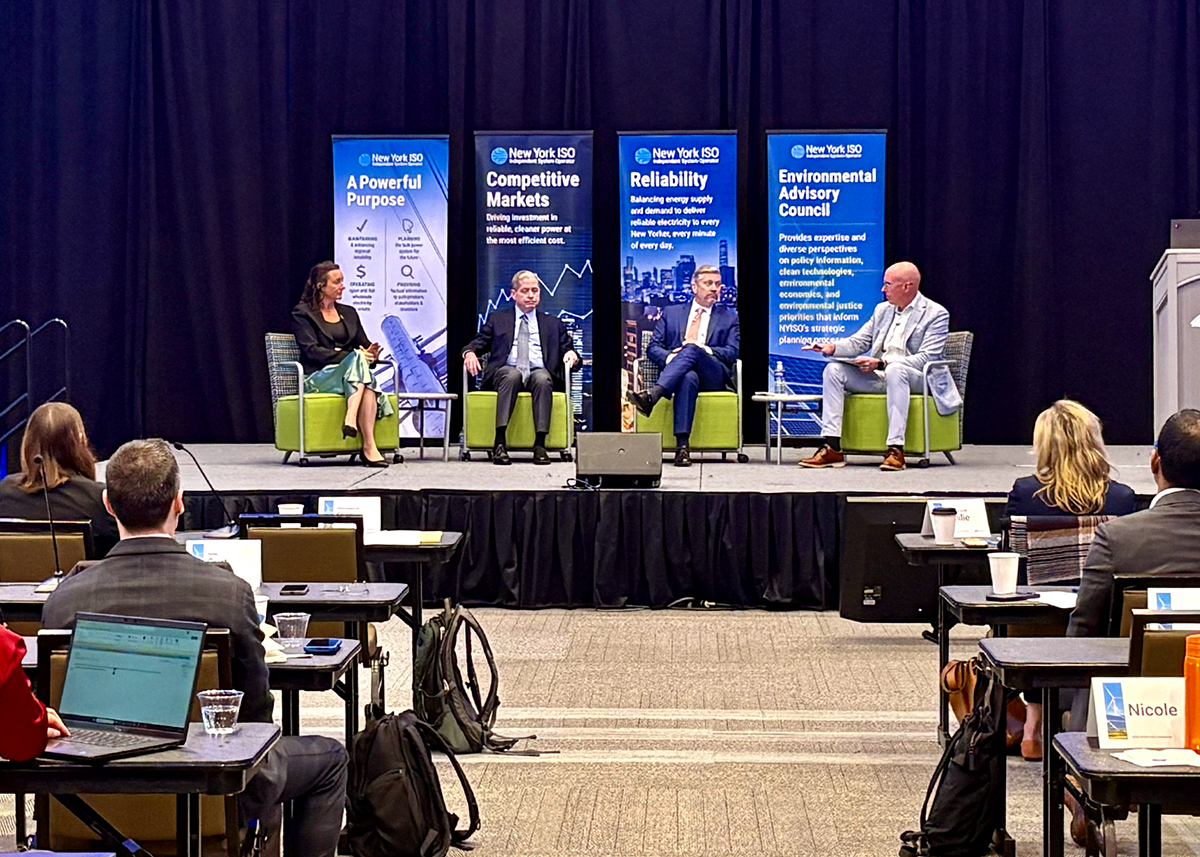
At its October meeting, NYISO’s Environmental Advisory Council heard from NYISO executives and industry leaders on reliability needs emerging in New York’s bulk power system, barriers to financing and development, and balancing environmental goals with these priorities in an era of unprecedented load growth.
The meeting drew a broad cross-section of market participants from all five NYISO sectors: Generation Owners, Other Suppliers, Transmission Owners, Public Power and Environmental Parties, and End-Use Consumers.
NYISO Senior Vice President of System & Resource Planning Zach Smith framed the discussion with an overview of the draft 2026 Reliability Needs Assessment, which for the first time shows a statewide resource deficiency by 2033. The RNA also identifies transmission security deficiencies in New York City and the Lower Hudson Valley, both beginning in summer 2032.
“This is an assessment of needs – and there are solutions that can meet them,” Smith said. “That’s what we’re here to talk about today.”
The eight-member council — comprised of experts in areas of energy, engineering, technology, and environmental policy — was formed in 2005 to provide the NYISO with information and analysis on the evolving dynamics between state and federal environmental policy and the NYISO’s mission of maintaining reliability and administering competitive wholesale electricity markets.
“When the EAC was formed, it was really meant to augment our stakeholder process,” NYISO President and CEO Rich Dewey said in his opening remarks. “We recognized early on that the environmental perspective was going to have an impact … so we sought out experts from outside our ecosystem to enhance the conversation and strategy.”

In her remarks, NYISO Executive Vice President and COO Emilie Nelson emphasized the necessity of an all-of-the above approach to attracting the resources needed to meet the grid’s challenges.
“The solutions, I would encourage you to think of them as plural,” she noted. “The idea that there is just one technology, one approach that will resolve the multitude of needs that we are facing … is just not expansive enough thinking from our perspective.”
The event featured a keynote address by Jim Walsh, Vice President of GE Vernova’s Consulting Services, and a panel discussion with executives at AlphaGen, National Grid Ventures and the Alliance for Clean Energy New York, looking at practical solutions to New York’s reliability challenges. Representatives from Blackstone and McKinsey & Company participated in a conversation on the conditions necessary to get enough capital flowing to build out New York’s energy future.
Walsh, of GE Vernova, which advises data center hyperscalers, highlighted the challenge of load modeling for data centers, which have highly intermittent demand profiles.
Compared to other large loads, like manufacturing and cryptocurrency miners, data centers’ variability poses unique challenges for the grid, with sub-second fluctuations that look like “saw teeth,” he said.
He described a maturing conversation among data hyperscalers which previously sought to access power as quickly as possible without having to foot the bill for infrastructure.
“That has transitioned now precipitously to ‘we understand that we cannot cause the average ratepayer to see a huge increase in their bill so we are going to have to finance some of this infrastructure ourselves,’” Walsh said.
He touched on various technological solutions being explored, including sophisticated modeling, thermal generation with carbon capture or direct air capture, battery support and small modular reactors (SMRs).
“The challenge is how fast we can we get there. On the SMRs, the good news is we are going from design to constructability in Ontario in like 18 months,” he said. “Broader deployment of SMRs will take more time.”
AI development is only part of the story, representing about 30-55% of projected load growth, Walsh noted. Even without data centers, New York is expected to see historic load growth.

In a pair of panel discussions, industry leaders acknowledged the significance of a statewide deficiency identified in the RNA and echoed the notion that a multi-pronged approach was necessary to meet looming reliability challenges.
“A lot of progress has been made in recognizing that there is a need … and that it will really take [an] all of the above approach to address it,” said Will Hazelip, President, National Grid Ventures U.S.. “But I think we need a clear recognition that we can have fossil-based resources and still meet our emissions and environmental goals in the long run.”
The conversation explored the concept of repowering existing thermal units, which are aging, and in many cases slated for closure, in order to retain or expand electricity capacity – an idea that now has recognition in the state’s long-term energy strategy.
Repowering will likely be considered as part of the suite of solutions that could address the statewide reliability need. Repowering – which involves retrofitting old, inefficient units with more carbon-efficient fossil technology or renewable technologies – could significantly reduce the state’s emissions footprint and bolster reliability, NYISO studies show.
“When we talk about repowering, what we mean is simply replacing what’s already on the system with different megawatts,” Smith said at the EAC meeting.
Panelists said their companies are hesitant to invest in and build out new resources in New York where the state and federal policy create uncertainty that they will be able to operate long enough to recoup investment costs. They cited New York’s Climate Leadership Community Protection Act (CLCPA) which mandates the state have a 100% emissions free grid by 2040.
“These existing plants require significant investment – you have to put real money into these plants – and if you don’t know if you will be around two or three years later, think about what goes through our minds,” said Curt Morgan, Chief Executive Officer at AlphaGen.
Panelists and NYISO leaders discussed the benefits and limitations of bilateral contracts in an environment when investors have few assurances that policies will support their projects’ continued operation.
Marguerite Wells, executive director of the Alliance for Clean Energy New York (ACE NY), emphasized that commercial certainty alone cannot resolve development challenges: the years required for siting, permitting and construction must also be considered against the timing of emerging reliability needs.
“Commercial certainty is only one element.” Wells said. “We have to also bake in the assumption that it takes many years to get through the siting and permitting and the commercial parts and then the actual construction so all of those planning horizon is a challenge.”
The NYISO’s wholesale energy markets are designed to attract investment through clear market signals, though in recent years those signals have been muted by policy interventions and outside contracts and incentives.
Weighing in on the financing side, Brian Kubeck, chairman of Blackstone’s Board of Transmission Developers (TDI), and Adam Rubin, associate partner at McKinsey & Co., described investors’ skepticism that competitive markets alone could draw investment needed to a massive increase in projected demand.
They recommended limited use of contracts to address acute near-term needs.
Asked about the NYISO’s position on contracts, Dewey noted that if improperly executed, contracts could potentially pass risks on to consumers.
“The environment we’re in now, with changing cost and supply structures, there’s a risk of rate shock if not done correctly,” Dewey said. “This isn’t a New York state problem, it’s global. When we think about our market strategy and market design, we think about how to balance the need to drive investment to build the infrastructure with protecting consumers.”

Noting the urgency of the needs identified in the RNA, EAC members stressed the potential for energy efficiency to offer reliability support in a short timeframe.
In response, Smith noted that NYISO demand forecasts incorporate expectations for energy efficiency improvements over time, indicating that the 2036 reliability need would be roughly 3,000 MW greater if efficiency wasn't considered.
“Energy efficiency is playing a significant role in slowing load growth, but electrification and large loads will overwhelm those savings and it's difficult to see where additional efficiencies beyond what we already expect will come from,” Smith said.